[ad_1]
Here we are: ours guide to arenas and scenarios of the series has finally arrived at the settings of Super Smash Bros. Ultimate. Here are all the levels created expressly for the latest addition to Nintendo Switch. In all, there are “only” fifteen missing (out of 115, so yes, alone 15), nine of which we will see today. In fact, we allude to the four scenarios of the base game, plus the five included as DLC with the first Fighters Pass. In this regard, we refer you to episodes 15 and 16 of our guide to the characters for the prices of each of them. In the appendix, we will talk about the Wall of pain and of ladder combo.
Preamble of the Appendix
Here’s what to expect from the arena and scenery guide of Super Smash Bros. Ultimate. In each of these twelve events, we will talk about each scenario, its origins, who are the fighters who play at home and, in the case of the DLC, also the availability. No scenario, except for the aforementioned downloadable content, needs to be unlocked: everything is available right from the start of the game. Ironically, you may need to unlock historically associated characters at certain levels, but there is a guide for that too. Furthermore, as for the wrestlers, here too the images precede their respective section. Are you ready?

New Donk City Hall – advanced guide to Super Smash Bros. Ultimate arenas and scenarios
One of the first unedited scenarios of the game is also one of the last traveling arenas of our guide to Super Smash Bros. Ultimate. The New Donk City Town Hall, as the name suggests, it is a tour that guides us through the various cornices of the building (a bit like the Torre Prisma consists only of the tower and not the entire Lumiose City). The layout of the platforms varies during the various transitions from the ground floor (walk-off) to the highest point.
- Origin: Super Mario Odyssey
- Stage representative of: Mario (first, seventh and eighth costumes), Luigi (first costume), Dr. Mario, Peach (first and seventh costumes), Bowser
- History: After years of fan speculation about the reasons behind Peach’s continued kidnappings, the one perpetrated by Bowser in Super Mario Odyssey it has marriage with the sovereign as its only real goal. In his tour of the world, Mario rediscovers the setting of the very first Donkey Kong different from the 75m he knew: now it has become a metropolis and the damsel to save, Pauline, is now the mayor of the city. If the background track in the arena is Jump Up, Super Star! or Ground Theme (Band Performance)i musicians they will appear in the background and contribute to the music as soon as a fighter touches them. If the song comes from Captain Toad: Treasure TrackerCaptain Toad will always appear at the top of the building.

Tower of Origins – advanced guide to Super Smash Bros. Ultimate arenas and scenarios
Given the presence of Link in his incarnation of The Legend of Zelda: Breath of the Wild, the inclusion of the ruined Hyrule was a must. There Tower of the Origins essentially consists of another Final Destination, but with a destructible canopy that regenerates over time. The old man who appears from time to time does not affect the fight.
- Origin: The Legend of Zelda: Breath of the Wild
- Stage representative of: Link (first and second costume)
- History: This version of Link remained in a state of hypersleep for a hundred years, then awakened in a cave in the Plateau of Origins. The world of Hyrule has fallen under the rule of Ganon, now at the height of his strength as “Calamity Ganon”. The Tower of Origins is only the first of the Sheikah Towers thanks to which the hero can obtain new points from which to glide, as well as expand his map. In every sector of Hyrule, Link must track down the descendants of his companions to put an end to the Ganon Calamity once and for all. And start, of course, to rebuild.

City Towers – advanced guide to Super Smash Bros. Ultimate arenas and scenarios
The arena dedicated to Splatoon it’s not necessarily built with the Inkling moveset in mind, but there’s nothing stopping you from re-enacting a clamshell if you like. The City Towers basically consist of a multi-storey car park. The platform at the base is solid, while both those above and the various slopes to go up and down can be crossed.
- Origin: Splatoon, Splatoon 2
- Stage representative of: Inkling, Mii Rifleman (costumes from Splatoon And Splatoon 2)
- History: The world of the series Splatoon is post-apocalyptic, and (at the writing of the guide) it remains to be seen what the “return of the Mammiferians” will be in Splatoon 3. Humans and mammals in general have become extinct, giving way to marine life forms that have evolved to remain on land as well (these are more hybrids than real amphibians). The City Towers are a multiplayer arena in the first two chapters, where they have the same ups and downs. Giudigatto and Giudigattino, which in Smash appear in the background, in the original game they decree the winner of the match.

Dracula’s Castle – advanced guide to Super Smash Bros. Ultimate arenas and scenarios
If you don’t have DLC and the lessons in the appendix don’t need you, the guide for you stops with this last scenario. The Dracula’s Castle it consists of a main platform with a concave floor, two moving platforms (they go up and down) and a slope to the right. The various monsters of the series Castlevania they remain in the background without affecting the match. If the tools are active, breaking the candles in the background generates items to collect. The edges of the scenery are darkened.
- Origin: series Castlevania
- Stage representative of: Simon, Richter
- History: The Belmont clan has been struggling with Dracula’s constant reincarnations for centuries, though sometimes the surname isn’t everything (see Soma Cruz). Even the castle itself boasts several incarnations, to the point that it is always unrecognizable between one game and another. Which, ironically, makes this Dracula’s Castle specifically canonically plausible. The staircase on the right in the scenario expressly evokes the iconic scene of Castlevania: Symphony of the Night.
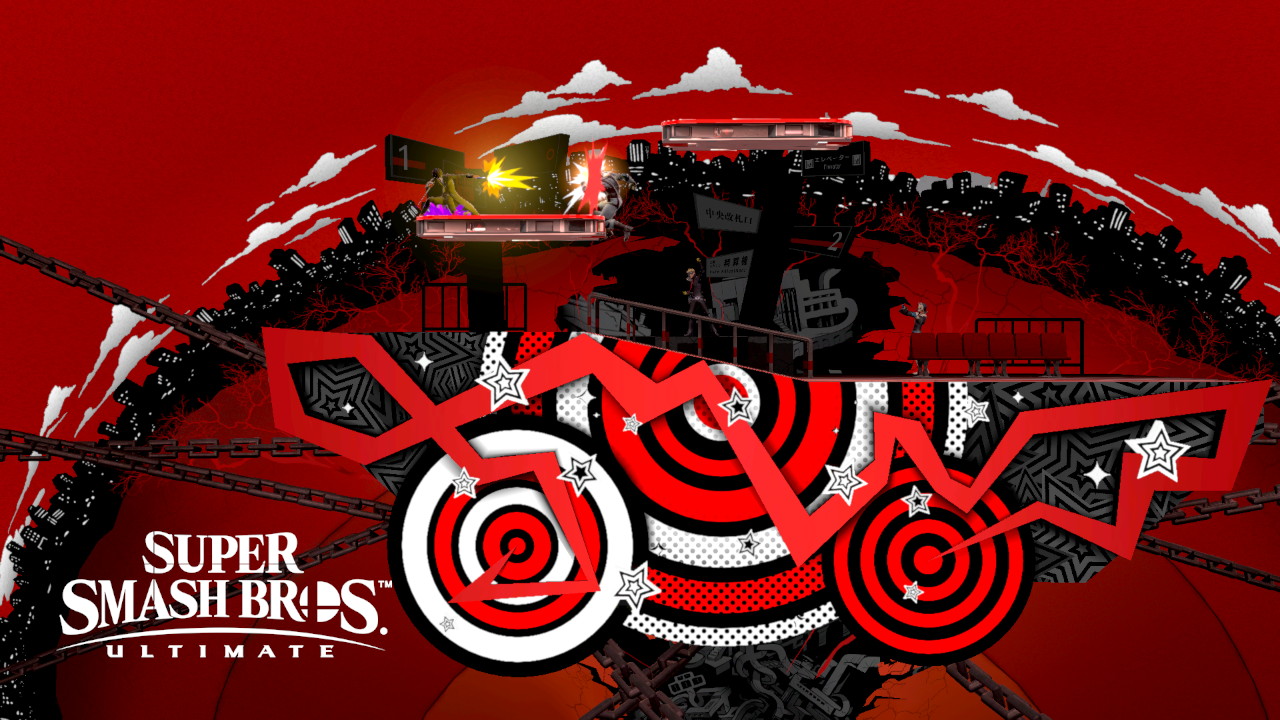
Mementos – advanced guide to Super Smash Bros. Ultimate arenas and scenarios
The bolt from the blue with which the first Fighters Pass opened was Joker da Person 5 (now actually coming to Nintendo Switch, and it was now too!), and with him in Smash also makes its debut Mementos. DLC scenarios tend not to overdo it with gameplay gimmicks, with some exceptions. In this case, it is mostly a solid platform with a slope in the middle, plus two traversable in the center and on the left. A third platform occasionally appears on the right. Walls can sometimes cover the top of the arena or its sides. Under the platform a train passes from time to time: be careful not to catch it on the snout!
- Origin: Person 5, Person 4, Person 3
- Stage representative of: Joker
- History: Mementos is a metaphysical representation of the collective subconscious. This colossal dungeon is located in the underground subway of Shibuya, Tokyo. Due to the size of this place, Morgana (the feline character in the Joker taunts) transforms into a vehicle to explore it more easily. The group of Phantom Thieves often returns to Mementos, specifically whenever they unlock new areas in the main campaign, for the purpose of gaining experience and more. In general, while enough corrupt people boast their own Palace, this is where Joker and company help less serious cases redeem themselves. How easter eggthe colors of the scenario change according to the music of the game of origin (Person 3, Person 4).
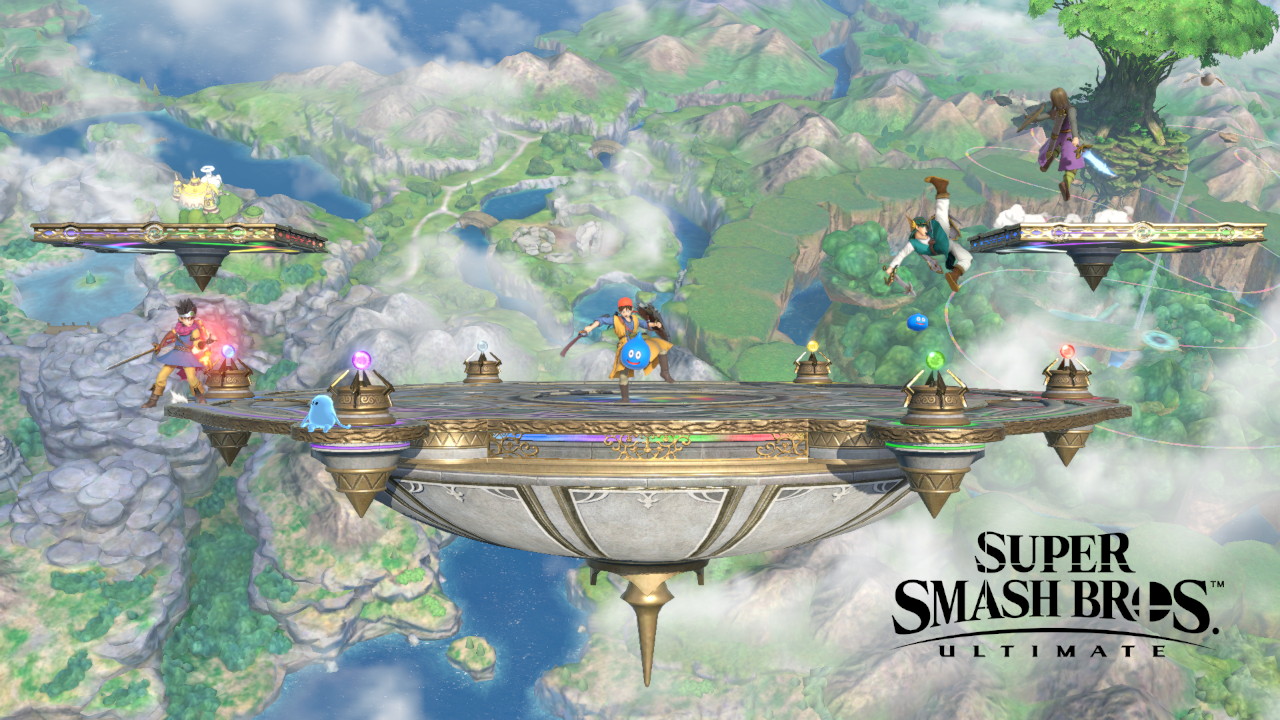
Altar of Ygdrasil – advanced guide to Super Smash Bros. Ultimate arenas and scenarios
Whoever bought the Hero will also have access to his “home”, theAltar of Ygdrasil. The arena remains anchored to the ground for the first moments of the fight, before moving the battle to the sky. The solid platform is occasionally accompanied by other smaller traversable ones, on which (if the tools are active) chests may appear. Be warned though: some of them may turn out to be toothed Skrigni, who will attack you (and still give a tool to those who defeat them).
- Origin: series Dragon Questmostly Dragon Quest XI: Echoes of a lost era
- Stage representative of: Hero (first and third costume)
- History: The world tree, Ygdrasil (written Yggdrasil in English), is not unique to Norse mythology. In the series Dragon Quest it will not connect the “nine kingdoms”, but it is still a recurring location. The placement of this incarnation of the tree, however, is in the world of the eleventh chapter of the saga. In this regard, the 3D model of the game map has been recreated from scratch specifically for the arena of Ultimate: Masahiro Sakurai almost gave up, and if he did we would end up with the Mount Huji.

Spiral Mountain – advanced guide to Super Smash Bros. Ultimate arenas and scenarios
The bombshell that concluded Nintendo’s E3 2019 was the return of an old friend. The youtuber JonTron said: “Nice to see you again, old friend … the mountains cannot be friends …But yes, the return of Spiral Mountain (included with Banjo and Kazooie) is very welcome. As the name implies, the arena is not limited to the top of this mound, on the contrary. When the signal appears (image above), the main platform begins to include other traversable platforms, a bridge, and even parts of the climb that surrounds the small promontory (pushing up, or down as appropriate, tools and characters).
- Origin: Banjo-Kazooie
- Stage representative of: Banjo and Kazooie
- History: Spiral Mountain represents the starting point of the original 1998 adventure, just outside Banjo’s house (background, image above). The bridge leads to the lair of the witch Gruntilda. A curiosity: beyond the cameos (Buzzbomb, Bottles, Jinjo), the scenario offers extra lives (the statue of Banjo, also in the image) and additional health points (honeycombs) in the same locations where they could be find in the original game.

King of Fighters Stadium – advanced guide to Super Smash Bros. Ultimate arenas and scenarios
Of the three fighting games represented in Smash, Terry’s universe (including with the arena) offers the most genre-true scenario. The King of Fighters stadium it’s a gigantic… stadium, in fact, where the KOs follow different rules. The arena is in fact well planted on the ground, and while the vertical KOs are always the same, to send an opponent sideways out of the scenario it is necessary to weaken and break through the force fields on the sides. Given the advantage this brings to characters with better options for vertical KOs, the arena is banned in competitive.
- Origin: series Fatal Furyseries The King of Fighters (“Stage”, The King of Fighters XII; “Antonov Super Arena”, The King of Fighters XIV)
- Stage representative of: Terry
- History: The arena incorporates the designs of the two stadiums mentioned above under the heading Origin, although it is the well-known Transcontinental Railroad (background of the Spirits Board for SNK’s IPs) the one most associated with Terry Bogard. The logo design in the center (“KOF”) comes from The King of Fighters ’96 (Kagura Stadium), with the addition of the Smash logo in place of the “O”). However, following the great tradition of classic two-dimensional fighting games, numerous cameos appear in the background based on the background music (50 songs, the maximum number for a DLC or a third-party IP). The exception is the alluring Mai Shiranui, due to the implicit absence of underwear; for the age rating, the Japanese CERO usually looks at all 3D models from below.

Garreg Mach Monastery – advanced guide to Super Smash Bros. Ultimate arenas and scenarios
In addition to a sigh of exasperation, when Byleth was confirmed he also brought the Garreg Mach Monastery. As the transparent platform we have shown above suggests, it is a traveling scenario. The main stages are four: a market (with destructible stalls), the school hall (with two very high candelabra, impossible to reach independently), the bridge (two walk-offs connected to each other) and the cathedral (the same thing, with the addition of two platforms).
- Origin: Fire Emblem: Three Houses
- Stage representative of: Byleth
- History: The monastery is Byleth Eisner’s main base when he accepts his teaching job at the school. Choosing to represent one of the three eponymous houses will influence the turn of the mid-game events. The three characters Claude, Edelgard and Dimitri, who appear as a cameo during the clashes, are also present among the costumes of Byleth (albeit from a purely chromatic point of view).

Eleventh deepening in the appendix: Wall of Pain and Ladder Combo
If you are a seasoned player by now, know that for every bird it is time to leave the nest. And if you feel able to leave the main platform of an arena to venture above an abyss, you may find that some characters have… a lot of freedom of action before they hit the ground. In the case of characters capable of chaining attacks such as Jigglypuff (above), we speak of “Wall of pain“(Wall of pain): attack after each consecutive jump to… lead the opponent over the edge. Similarly, we speak of Ladder combo (Combo ladder) when a character enjoys multiple upward attacks capable of dragging the opponent with him. Experiment with caution!
[ad_2]